Over the past year, a quiet shift has been happening in how software gets built. Tools like Claude, ChatGPT, and GitHub Copilot are changing the development process in ways that feel surprisingly familiar. For many engineers, the experience resembles something developers have practiced for years: pair programming. The difference now is that one side of the “pair” is an AI assistant, instead of two developers sitting side by side, it’s a human collaborating with an AI, sharing a single keyboard and building software together.
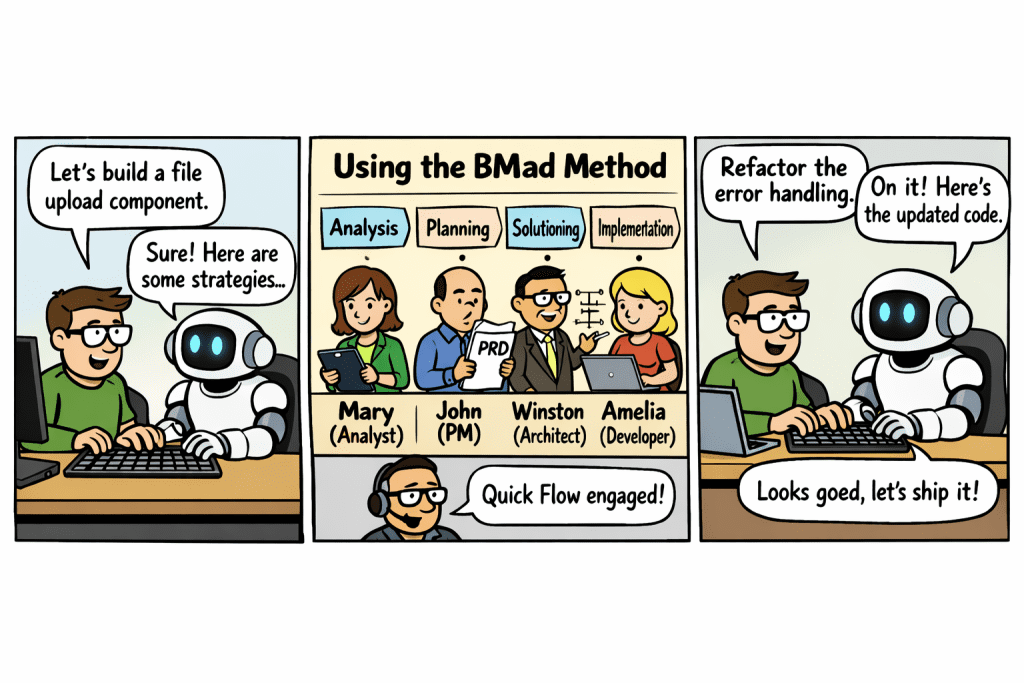
The challenge is that most people still think of AI coding tools as autocomplete on steroids. When used that way, asking AI to simply do the work — the results feel inconsistent or shallow. What many teams haven’t yet realized is that these tools work best when treated like a real development partner. The shift is subtle but powerful: instead of asking AI to generate code in isolation, you collaborate with it the same way you would with another engineer sitting beside you.
AI as a Pair Programming Partner
Traditional pair programming involves two roles:
- Driver — the person typing at the keyboard
- Navigator — the person reviewing, thinking ahead, and suggesting improvements
When working with AI tools like Claude, the same pattern emerges naturally. The developer remains the driver, making architectural decisions, steering the problem, and validating outcomes. The AI becomes the navigator, helping explore options, identifying edge cases, generating scaffolding, and reviewing logic.
The interaction might look something like this:
- Developer frames the problem — “I’m building a React component that handles document uploads and validation.”
- AI suggests approaches — architecture patterns, libraries, validation strategies.
- Developer refines the direction — “Let’s use TypeScript and handle file size and MIME type validation.”
- AI generates an initial implementation.
- Developer critiques and improves — “This logic needs better error handling.”
- AI helps refactor or extend.
This loop continues until the feature is complete. The human remains responsible for judgment, while the AI accelerates thinking and execution.
Working this way changes how development feels day to day. AI eliminates much of the mechanical overhead — boilerplate, documentation lookup, and scaffolding can be generated instantly. When you’re stuck on a design decision, AI can quickly explore multiple options, acting as a brainstorming partner. It can evaluate code continuously, identifying edge cases, suggesting refactoring opportunities, and highlighting potential bugs. For developers exploring new stacks, it can explain concepts in real time while generating working examples.
The loop becomes shorter and more collaborative:
Traditional workflow: Think → Search → Read Docs → Write Code → Debug
AI pair programming workflow: Think → Discuss with AI → Generate → Refine Together
When Speed Needs Structure
This is where many teams hit a second challenge. Once you’ve experienced how fast the AI pair programming loop moves, a new problem emerges: speed without structure can lead to messy architectures, unclear requirements, and rework later. When developers rely too heavily on prompting without a clear workflow, the process can become chaotic.
The real opportunity isn’t just coding faster — it’s creating a repeatable process where AI helps move work from idea to production in a disciplined way. The best developers in this new world won’t simply be the ones who write the most code. They’ll be the ones who know how to direct the system, ask the right questions, and collaborate effectively. And to do that consistently across a team, you need more than a good instinct for prompting. You need a framework.
That’s where the BMad Method comes in.
Structured AI Collaboration with the BMad Method
The BMad Method — which stands for Build More Architect Dreams — is an AI-driven development framework that takes you from ideation and planning all the way through to implementation. Rather than treating AI like a code generator you prompt ad hoc, BMad gives you specialized AI agents, guided workflows, and structured context management that adapts to your project’s complexity, whether you’re fixing a bug or building an enterprise platform.
It works with any AI coding assistant that supports custom system prompts, including Claude Code (the recommended option), Cursor, and Codex CLI.
The key insight behind BMad is that AI agents work best when they have clear, structured context. Without it, agents make inconsistent decisions. BMad builds that context progressively across phases, so each step informs the next.
How the BMad Workflow Is Structured
BMad organizes development into four phases, each producing documents that feed into the next.
Phase 1 — Analysis (optional) Before committing to building anything, you can explore the problem space. BMad provides workflows for brainstorming, market research, domain research, and capturing a strategic product brief. This phase is optional but valuable when requirements aren’t yet clear.
Phase 2 — Planning Define what to build and for whom. This is where you create a Product Requirements Document (PRD) that captures functional and non-functional requirements, and optionally a UX spec if user experience decisions need to be made explicit.
Phase 3 — Solutioning Decide how to build it. This phase produces an architecture document with decision records, breaks requirements into epics and stories, and includes an implementation readiness check before any code is written, a deliberate gate that prevents the “just start coding” trap that leads to rework.
Phase 4 — Implementation Build one story at a time. BMad’s developer agent implements stories, a code review workflow validates quality, and a retrospective captures lessons learned after each epic.
Quick Flow: When You Don’t Need the Full Process
BMad is pragmatic. Not every task warrants four phases of planning. For bug fixes, refactoring, small features, and prototyping, there’s a parallel track called Quick Flow that takes you from idea to working code in just two steps:
bmad-quick-spec— A conversational planning process that scans your codebase, asks informed questions, and produces atech-spec.mdfile with ordered implementation tasks, acceptance criteria, and a testing strategy.bmad-quick-dev— Implements the work against the spec, runs a self-check audit against all tasks and acceptance criteria, then triggers an adversarial code review before wrapping up.
If Quick Flow detects that scope is larger than it first appeared, it offers to escalate automatically to the full PRD workflow — without losing any work already done.
The Role of Specialized Agents
One of the things that makes BMad distinct from a generic AI workflow is that it uses named, specialized agents for different roles:
| Agent | Role |
| Mary (Analyst) | Brainstorming, research, product brief |
| John (Product Manager) | PRD creation and validation |
| Winston (Architect) | Architecture and technical decisions |
| Bob (Scrum Master) | Sprint planning and story creation |
| Amelia (Developer) | Implementation and code review |
| Barry (Quick Flow) | Quick spec and quick dev |
| Paige (Technical Writer) | Documentation |
Each agent operates within a structured workflow rather than responding to open-ended prompts. This is what makes output predictable and consistent, rather than dependent on how well you phrased your last message.
The Difference Structure Makes
Teams experimenting with AI-assisted development typically go through a predictable evolution:
Stage 1 — Prompting for code. Developers ask AI to generate snippets or functions. Results are fast but inconsistent.
Stage 2 — AI as pair programmer. Developers collaborate interactively with AI to build features. Better, but still ad hoc.
Stage 3 — Structured AI workflows. Teams introduce frameworks like BMad to manage the process end to end.
The leap from stage two to stage three is significant. Without structure, AI development tends to produce inconsistent code quality, unclear design decisions, and duplicated logic. With a framework like BMad, you get predictable development cycles, better architectural outcomes, and artefacts that help onboard new engineers faster.
What This Means for Modern Development Teams
AI is changing how software gets written, but the bigger transformation is how software gets designed and delivered.
The pair programming analogy that opened this post is still the right mental model: the human as driver, the AI as navigator. But BMad takes that model and makes it work at scale, across a whole team, across a whole project lifecycle, not just in a single coding session.
Pair programming with AI gives developers speed. Frameworks like the BMad Method give teams discipline. Together they create something more durable than either alone:
Human creativity + AI acceleration + structured workflow.
Your AI partner is available 24/7, can explore thousands of possibilities instantly, and never gets tired. The question is whether your process is good enough to make the most of that.
Two minds. One keyboard. A system built to last.
Learn more and get started at docs.bmad-method.org