Over the past year, a quiet shift has been happening in how software gets built. Tools like Claude, ChatGPT, and GitHub Copilot are changing the development process in ways that feel surprisingly familiar. For many engineers, the experience isn’t completely new, it resembles something developers have practiced for years: pair programming. The difference now is that one side of the “pair” is an AI assistant. Instead of two developers sitting side by side, it’s a human developer collaborating with an AI, sharing a single keyboard and building software together.
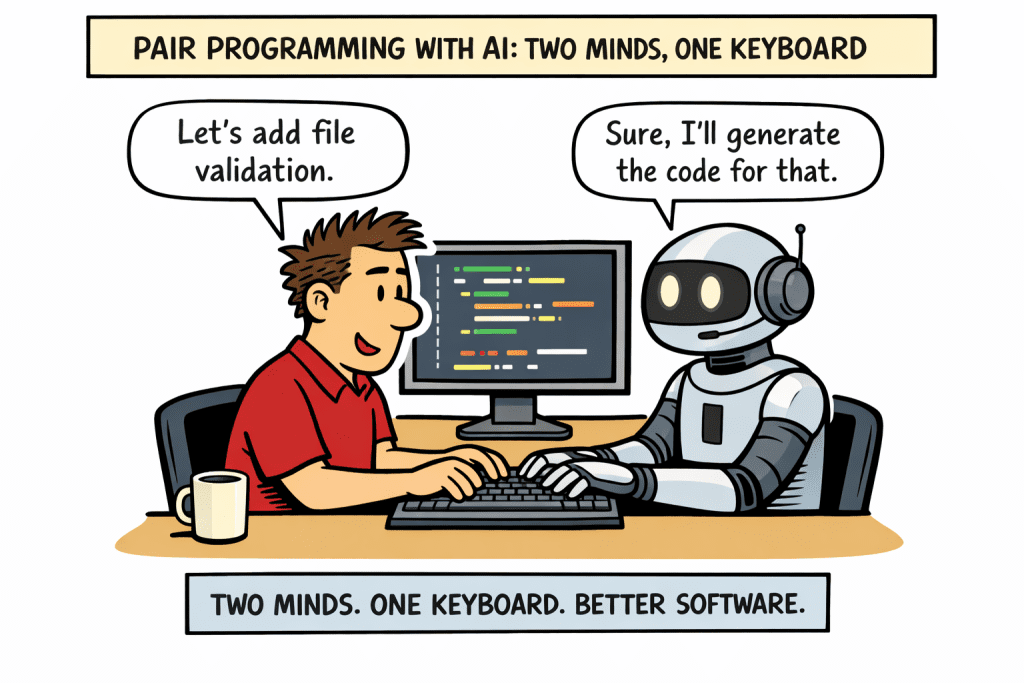
The challenge, however, is that most people still think of AI coding tools as autocomplete on steroids. They expect them to simply generate code or answer questions. When used this way, the results can feel inconsistent or shallow. What many teams haven’t yet realized is that these tools work best when treated like a real development partner. The shift is subtle but powerful: instead of asking AI to do the work, you collaborate with it the same way you would with another engineer sitting beside you.
The Solution: AI as a Pair Programming Partner
Traditional pair programming usually involves two roles:
- Driver – the person typing at the keyboard
- Navigator – the person reviewing, thinking ahead, and suggesting improvements
When working with AI tools like Claude, the same pattern emerges naturally.
The developer remains the driver, making architectural decisions, steering the problem, and validating outcomes. The AI becomes the navigator, helping explore options, identifying edge cases, generating scaffolding, or reviewing logic.
The interaction might look something like this:
- Developer frames the problem
“I’m building a React component that handles document uploads and validation.” - AI suggests approaches
It may propose architecture patterns, libraries, or validation strategies. - Developer refines the direction
“Let’s use TypeScript and handle file size and MIME type validation.” - AI generates an initial implementation
- Developer critiques and improves the code
“This logic needs better error handling.” - AI helps refactor or extend
This loop continues until the feature is complete.
The important part is that the human remains responsible for judgment, while the AI accelerates thinking and execution.
What Changes When You Work This Way
Treating AI like a pair programmer changes how development feels day-to-day.
1. Faster Iteration
AI eliminates much of the mechanical overhead in development. Boilerplate, documentation lookup, and scaffolding can be generated instantly.
2. A Second Brain
When you’re stuck on a design decision, AI can quickly explore multiple options. It becomes a brainstorming partner.
3. Constant Code Review
AI can evaluate code continuously:
- identifying edge cases
- suggesting refactoring opportunities
- highlighting potential bugs
4. Learning While Building
For developers exploring new stacks, whether it’s React, Supabase, or a new API, AI can explain concepts in real time while generating working examples.
Evidence: How Teams Are Already Using AI Pair Programming
Across engineering teams, this pattern is emerging naturally.
Many developers using tools like Claude or Copilot report that their workflow now looks like this:
- Describe the feature in natural language
- Generate an initial implementation
- Iterate with AI on improvements
- Validate and finalize the code
Instead of searching documentation or browsing Stack Overflow for answers, developers interact conversationally with their development partner.
Even experienced engineers are adopting this approach because it amplifies their productivity without removing control. AI becomes a force multiplier, not a replacement.
A helpful way to visualize the workflow:
Traditional workflow
Think → Search → Read Docs → Write Code → Debug
AI pair programming workflow
Think → Discuss with AI → Generate → Refine Together
The loop becomes shorter and more collaborative.
Why This Matters for the Future of Software Development
The biggest misconception about AI in development is that it will replace engineers. In reality, it’s transforming how engineers work together with machines.
The best developers in this new world won’t be the ones who simply write the most code. They will be the ones who know how to direct the system, ask the right questions, and collaborate effectively with AI tools.
In many ways, AI is simply extending a practice developers already understand: pair programming. The difference is that your partner is now available 24/7, can explore thousands of possibilities instantly, and never gets tired.
For teams building modern applications, the opportunity is clear:
- Treat AI like a collaborator, not a tool
- Work in conversational loops rather than isolated coding sessions
- Use AI to accelerate thinking, not just typing
The result isn’t just faster software development, it’s a fundamentally more interactive way of building software.
If you’re experimenting with AI tools today, try changing your mindset on the next feature you build. Instead of asking the AI to generate code, sit down with it like a colleague.
Two minds. One keyboard. Better software.